Elevate your local knowledge
Sign up for the iNFOnews newsletter today!
Sign up for the iNFOnews newsletter today!
Selecting your primary region ensures you get the stories that matter to you first.
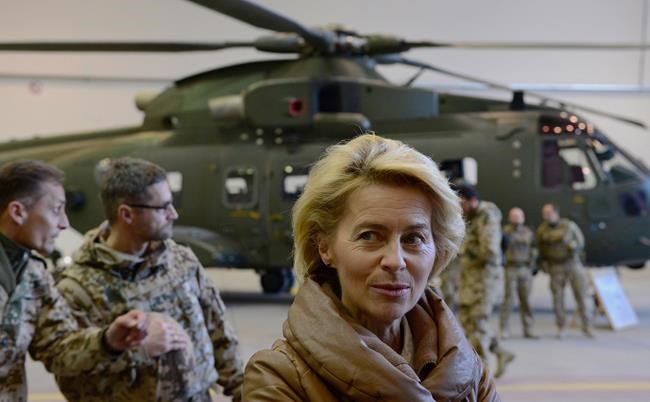
BERLIN – Germany is affirming its growing role on the world stage in new security guidelines that mark another step away from its caution after World War II.
A draft defence policy paper obtained by The Associated Press Tuesday and due to be presented on Wednesday states that “Germany is a globally highly connected country … which has a responsibility to actively shape the global order.”
It formalizes what leading officials have been saying for the past 2 1/2 years — a period in which Germany has played a leading diplomatic role in Ukraine’s conflict and joined a campaign to support the fight against Islamic insurgents in Mali, among other things.
Germany also sent weapons to Kurdish fighters in northern Iraq, breaking with a previous reluctance to send arms into conflict situations. But although it has stepped up its diplomatic and military role, there’s still little chance of the government — which has to get all military missions approved by Parliament — dispatching combat troops to global hotspots in the same way as European allies France and Britain, and still less unilaterally.
The so-called “white book,” the first such security policy review since 2006, stresses that Germany has no intention of acting alone and that all military action and diplomatic crises need to be tackled and solved with the country’s partners and allies.
“The armed forces are focused on acting in a multilateral framework,” it says. “When it comes to taking responsibility for international security we are strongly dependent on the co-ordinatedco-operation with our partners.”
However, the government also says that “Germany is ready to introduce itself as an early, determined and substantial source of inspiration in the international debate, to live responsibility and take on leadership.”
The paper also raises, albeit vaguely, the possibility of other European Union countries’ citizens serving in Germany’s military. “Opening the armed forces for citizens of the EU would offer not just far-reaching integration and regeneration potential for their personnel robustness, but also would be a strong signal for a European perspective,” it says.
Germany backs NATO nations’ pledge to spend 2 per cent of their national incomes on defence and is increasing defence spending. Still, Chancellor Angela Merkel acknowledged last week that “a lot remains to be done” to reach that mark — officials estimate that Germany’s defence spending will increase from 1.19 per cent of gross domestic product this year to 1.21 per cent in 2017.
Germany emerged slowly from its post-World War II diplomatic shell after reunification in 1990. Former Chancellor Helmut Kohl broke a taboo against troops abroad by sending military medics to support the U.N. mission in Cambodia in 1992. But by the early 2000s, Germany had thousands of troops abroad — taking significant roles in Afghanistan and Kosovo, among other places.
News from © The Associated Press, . All rights reserved.
This material may not be published, broadcast, rewritten or redistributed.

This site is protected by reCAPTCHA and the Google Privacy Policy and Terms of Service apply.
Want to share your thoughts, add context, or connect with others in your community?
You must be logged in to post a comment.