Elevate your local knowledge
Sign up for the iNFOnews newsletter today!
Sign up for the iNFOnews newsletter today!
Selecting your primary region ensures you get the stories that matter to you first.
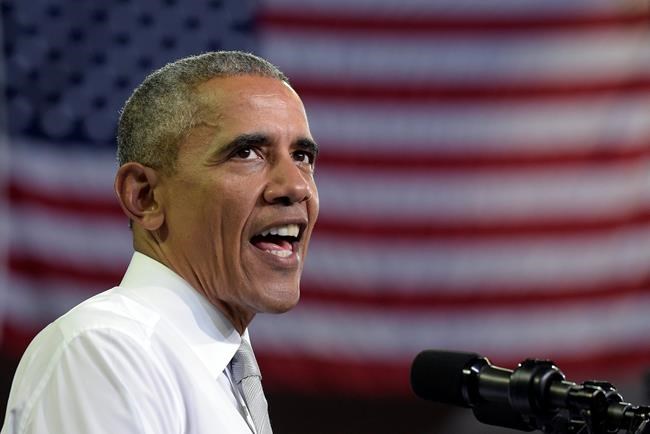
WASHINGTON – The latest clamour over Hillary Clinton’s emails has put Barack Obama in a spot where no president wants to be: caught between his attorney general, his FBI director and his preferred White House successor.
With accusations of political interference flying, Obama is trying to keep his distance as an internal government spat bursts into public view. In a bit of unwelcome irony, Obama’s strict adherence to the notion of judicial independence, preached throughout his years in office, has hamstrung his efforts to defend Clinton against a GOP onslaught.
Democrats hope Obama’s hands-off approach to the FBI forms a powerful contrast to Donald Trump, whose insistence that Clinton should be in prison seems to skip a few steps of due process. But on Monday, White House spokesman Josh Earnest was left to explain how Obama could be silent about an explosive issue.
“I’ll neither defend nor criticize what Director Comey has decided to communicate to the public about this investigation,” Earnest said, referring to FBI Director James Comey. During an hour-plus-long briefing that focused almost exclusively on Comey’s decision, Earnest used some version of that formulation — “neither defend nor criticize” — 10 times.
Criticism of Comey has mushroomed since his Friday bombshell, announced in a letter to Congress: The FBI is investigating more emails related to Clinton to see whether they contain classified information.
In a stunning airing of internal disagreement, some Justice Department officials blamed the FBI by making clear to reporters that they had cautioned Comey against notifying Congress just before next Tuesday’s election, and he’d ignored their advice.
Hillary Clinton, senior lawmakers and dozens of former prosecutors from both parties have all assailed Comey’s decision.
The emails were found during an unrelated investigation involving former Rep. Anthony Weiner, the estranged husband of a close Clinton aide. But Comey’s letter said it was unclear what the emails would show or whether they’d be significant, leaving voters at a loss to know whether they should rethink their choice for president. Though investigators are rushing to review the emails, it’s uncertain if the investigation will wrap up before Election Day.
Deploying rhetorical gymnastics, Earnest said Obama believed strongly in centuries-old FBI and Justice Department traditions “that limit public discussion of investigations.” Yet Earnest declined to connect the dots by faulting Comey’s decision to pursue the opposite approach. Earnest argued he couldn’t second-guess the FBI director without knowing all the circumstances behind his decision.
Commenting any further on the unseemly clash would put Obama in the position of siding either with the FBI or with his Justice Department. And criticizing Comey for informing Congress about the new emails could elicit accusations that Obama was trying to put the thumb on the scale to help Clinton.
So the White House opted to praise both Comey — “he’s a man of good character,” Earnest said — and Lynch, while glossing over the difficult question voters now face about what and whom to believe. Obama was not expected to mention the issue during any of the half-dozen campaign stops he’ll make for Clinton between now and Election Day.
But Earnest did concede at least one point: Comey’s letter, intended to keep Congress in the loop, had backfired.
“Clearly it had the opposite of the intended effect,” Earnest said. “I think we can all agree on that.”
___
Reach Josh Lederman on Twitter at http://twitter.com/joshledermanAP
News from © The Associated Press, . All rights reserved.
This material may not be published, broadcast, rewritten or redistributed.

This site is protected by reCAPTCHA and the Google Privacy Policy and Terms of Service apply.
Want to share your thoughts, add context, or connect with others in your community?
You must be logged in to post a comment.