Elevate your local knowledge
Sign up for the iNFOnews newsletter today!
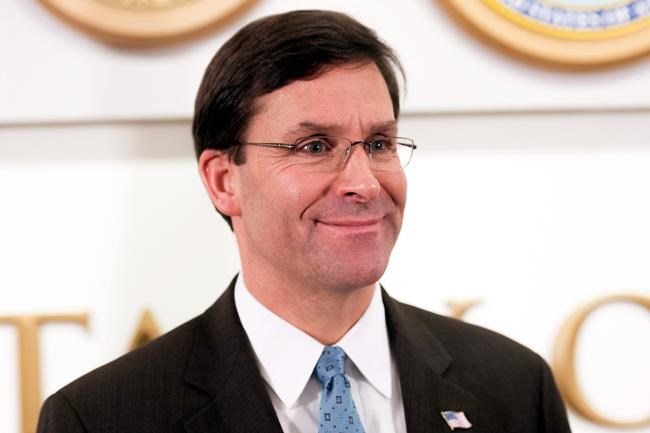
WASHINGTON – Barely four months into his tenure, Defence Secretary Mark Esper is making his second trek across the Pacific. And yet it is the Middle East – most recently a near-war with Iran and an actual war in Syria – that in Washington commands more attention and demands more American troops.
Esper’s Asia visits illustrate the central feature of a revamped U.S. defence strategy: Focus first on China as a threat to U.S. global predominance, rather than remain bogged down in a generation-long fight against extremist groups.
Esper was flying to South Korea on Wednesday for consultations on jointly defending against North Korea, whose nuclear arsenal remains a key focus for Pentagon war planners. His weeklong trip is expected to include a meeting in Bangkok with China’s defence minister, Gen. Wei Fenghe — their first direct contact other than a Nov. 5 video phone call.
With China’s disputed territorial claims in the South China Sea in mind, Esper also will visit Vietnam, a former U.S. enemy, as well as the Philippines, a longtime ally. The Vietnamese, who contest some of China’s claims in the South China Sea, have increasingly looked to Washington as a security partner, despite political differences.
Esper’s first overseas trip after winning Senate confirmation in July was to Asia. But since then the issues that have dominated his tenure include an unprecedented missile and drone attack on the heart of Saudi Arabia’s oil industry that the U.S. blamed on Iran. It prompted the Pentagon to send additional fighter jets, troops and air defences to the Saudi kingdom. Since May, the U.S. has sent about 14,000 troops into the Middle East, including Air Force bombers to Qatar and Navy ships to maintain maritime security in the Persian Gulf area.
Late last year, the U.S. removed Patriot missile batteries from Kuwait, Bahrain and Jordan in line with the new strategy of focusing first on China, but the spike in Iran tensions compelled the Pentagon to reverse those moves. And in July, the U.S. put forces back into Saudi Arabia’s Prince Sultan Air Base, which had been a hub of American air power in the 1990s but was abandoned by Washington after it toppled Iraqi strongman Saddam Hussein in 2003.
The U.S. also has 5,200 troops in Iraq to support the beleaguered Baghdad government’s efforts to defeat remnants of the Islamic State group. The U.S. pulled its forces out of Iraq in 2011 but returned three years later after IS fighters swarmed across the border from Syria to capture control of large parts of the country.
Bruce Bennett, a senior defence analyst at the RAND Corp., says that although the Pentagon clearly is paying more attention to China and Russia, its overall approach leaves some Asian allies wondering how long they can count on U.S. support.
“The military folks I talk to in Korea, they tend to call the United States a flaky ally,” Bennett said. In their view, “The U.S. might make a commitment and then step back from it” — a worry reinforced by President Donald Trump’s musings about pulling American troops out of South Korea and his administration’s insistence that the Koreans pay a bigger share of the cost of the U.S. military presence.
Pentagon officials knew when they announced a new China/Russia-focused defence strategy in January 2018 that the Middle East would remain a strain, and officials say they are prepared to face that problem even as they focus more on Asia.
“We’ve got some real-world challenges going on, and so we have to be able to walk and chew gum at the same time while we’re managing those situations in the Middle East,” Randall Schriver, Esper’s top adviser on Asia and the Pacific, said last week.
Esper says that implementing the new defence strategy, which he inherited from his predecessor, former Defence Secretary Jim Mattis, is a work in progress.
“I need to engage more, I need to redeploy forces to the area, I need to be more present in the (Asia-Pacific) region,” he told reporters after meeting with his Australian counterpart at the Pentagon last month.
This shift in focus has been long in coming. The Obama administration tried it, announcing in 2012 a “pivot to the Pacific.” But then came the rise of the Islamic State group and a return to U.S. fighting in the Middle East, first in Iraq and later in Syria.
In October, Esper announced that Trump had approved withdrawing all U.S. troops from northern Syria, but just days later the president authorized a broadening of the counterterrorism mission in Syria to include securing Syrian oil fields. The Pentagon is now sending an armoured force into the oil fields, and the total number of American troops in Syria, even after the pullout from the country’s north is completed, will likely be only a few hundred fewer than when Trump declared he was withdrawing.
Gen. Mark Milley, the new chairman of the Joint Chiefs of Staff, said the 18-year-old war in Afghanistan also is likely to remain a draw on defence resources and troops.
“I suspect it will be ongoing into the future for several more years,” Milley said Sunday in an interview with ABC News.
News from © iNFOnews.ca, . All rights reserved.
This material may not be published, broadcast, rewritten or redistributed.

This site is protected by reCAPTCHA and the Google Privacy Policy and Terms of Service apply.
Want to share your thoughts, add context, or connect with others in your community?
You must be logged in to post a comment.