Elevate your local knowledge
Sign up for the iNFOnews newsletter today!
Elevate your local knowledge
Sign up for the iNFOnews newsletter today!
Select Region
Selecting your primary region ensures you get the stories that matter to you first.
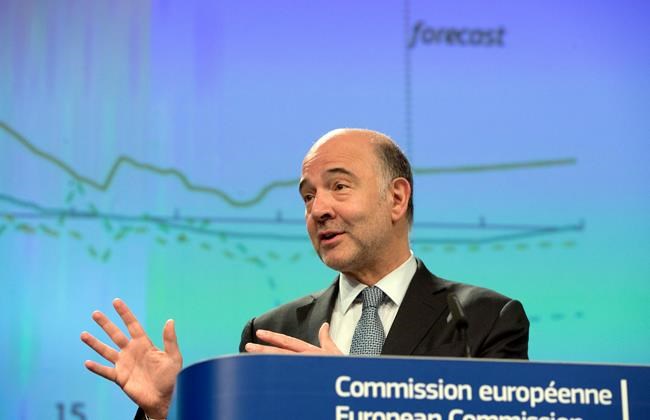
BRUSSELS – Economic growth across the European Union will remain robust this year and next, particularly when compared with Britain, which is set to leave the bloc in less than a year, the EU’s executive branch said Thursday.
In its spring forecast, the European Commission said it expects economic growth across the 28-country EU to dip to 2.3 per cent this year, from last year’s decade-high rate of 2.4 per cent. Next year, it expects a further easing to 2 per cent. For the 19-country eurozone, the Commission forecasts the same levels of growth this year and next.
Pierre Moscovici, the commissioner responsible for economic matters, said the forecasts are further evidence that the debt crisis that has ravaged the eurozone and many of its members, notably Greece, is now past.
“All indicators are currently flashing green,” he said. “Europe has finally turned the page of the crisis.”
Still, he said there was no room for complacency and warned of the perils of trade protectionism amid fears that U.S. President Donald Trump will go ahead with plan to impose tariffs on steel and aluminum. Earlier this week, he exempted the EU for a month.
“Protectionism only creates problems and we hope that we can find ways and means of avoiding that,” Moscovici said.
He also urged eurozone governments to push on with economic reforms, particularly to their labour markets. Though the rebound in growth over the past couple of years has seen unemployment across the bloc fall, the jobless rate remains elevated at 8.5 per cent. It is exorbitantly high in some countries like Greece, where more than one in five people are out of work.
“In short, we have come a long way but now is not the time to sit down and relax,” he said.
The eurozone has benefited from waning fears over debt-ridden Greece and the defeat of a run of populist — and anti-euro — politicians in elections in France and the Netherlands.
Moscovici made much of the fact that for the first time since the euro was born in 1999, no country in 2018 will have a budget deficit over 3 per cent of annual GDP — a key limit that governs the single currency and which has been flouted by many countries.
France, for example, is expected to exit this year the European procedure for “excessive deficit” for the first time in a decade as its public finances come within the rules. The Commission said France’s budget deficit in 2017 was 2.6 per cent of GDP and that it is expected to fall to 2.3 per cent this year. France, the eurozone’s second-largest economy, had not met the EU’s limit of 3 per cent since the financial crisis of 2008.
The French government argues the improvement is evidence that President Emmanuel Macron’s strategy to reduce public spending is working.Economists say Europe’s economic rebound has also helped the French economy and boosted tax receipts.
The Commission, meanwhile, said Britain will continue to lag the eurozone over the coming years, forecasting growth of only 1.5 per cent this year and 1.2 per cent next, with the economy hobbled by Brexit uncertainty.
Though the country is due to leave the EU on March 29, 2019, the future relationship between the two remains unclear. In its forecasts, the EU included the important proviso that it was based on a status quo, which is likely to change in light of Brexit developments.
Separately, the European Union’s statistics agency said inflation in the eurozone eased in April, a development that may disappoint policymakers at the European Central Bank.
The headline measure of consumer price inflation dipped in the year to April to 1.2 per cent from 1.3 per cent the month before. Most economists were predicting no change.
What’s likely to be a bigger concern for rate-setters is that the core rate, which strips out potentially volatile items like energy and food, fell to just 0.7 per cent in the year to April from 1 per cent the month before. That fall shows underlying inflation largely linked to wages remains weak.
The Commission forecast that eurozone inflation this year would remain unchanged at 1.5 per cent, rising only to 1.6 per cent next year.
Though the European Central Bank has been encouraged by the economy’s momentum, it’s still pursuing crisis-era stimulus policies to get the annual rate of inflation back to its goal of just below 2 per cent. Investors think the bank will start reining in those policies only when inflation is showing clear signs of settling around that level. Only then is it expected to consider bringing forward the end of its bond-buying program and start raising its interest rates, including its main benchmark which is at zero.
___
Pylas reported from London. Sylvie Corbet contributed from Paris.
News from © iNFOnews.ca, . All rights reserved.
This material may not be published, broadcast, rewritten or redistributed.

This site is protected by reCAPTCHA and the Google Privacy Policy and Terms of Service apply.
Want to share your thoughts, add context, or connect with others in your community?
You must be logged in to post a comment.