Elevate your local knowledge
Sign up for the iNFOnews newsletter today!
Sign up for the iNFOnews newsletter today!
Selecting your primary region ensures you get the stories that matter to you first.
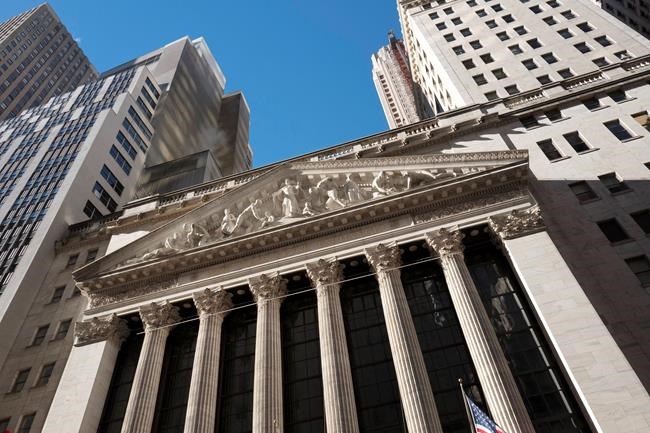
U.S. stock indexes overcame an afternoon wobble to close mostly higher Wednesday after the Federal Reserve said it would start reducing its huge bond portfolio next month and was still on track to raise interest rates later this year.
The central bank’s announcement drove bond yields higher, lifting shares in banks and other financial companies. Banks benefit from higher bond yields because it means they can charge higher interest rates on loans.
High-dividend stocks like utilities and household goods makers fell. Income-seeking investors find those stocks less appealing when bond yields move higher.
“The announcement was pretty much in line with what was expected,” said David Chalupnik, head of equities at Nuveen Asset Management. “So far, the market is taking it in stride, but I don’t know if it should. This will slowly impact growth.”
The Standard & Poor’s 500 index inched up 1.59 points, or 0.1 per cent, to 2,508.24. The Dow Jones industrial average rose 41.79 points, or 0.2 per cent, to 22,412.59. The modest gains nudged both indexes to record highs, extending a run of milestones that stretches back to last week.
The Nasdaq composite lost 5.28 points, or 0.1 per cent, to 6,456.04. The Russell 2000 index of smaller-company stocks added 5.02 points, or 0.4 per cent, to 1,445.42.
Trading on Wall Street had been mostly subdued this week ahead of the Fed’s announcement.
Fed policymakers decided to leave the central bank’s short-term benchmark interest rate between 1 per cent and 1.25 per cent, but also said they still expect to increase the rate one more time this year and three times in 2018, if persistently low inflation rebounds.
The Fed has modestly raised the rate four times since December 2015 after keeping it at a record low for seven years after the 2008 financial crisis.
In addition, the Fed said it will begin to gradually unwind its $4.5 trillion balance sheet next month. The portfolio primarily consists of government and mortgage-backed bonds. The move will gradually increase long-term borrowing rates.
The prospect of another Fed rate hike this year at a time when the U.S. economy is growing modestly and may slow somewhat from the impact of hurricanes Harvey and Irma, could be bad news for stocks the next few weeks, Chalupnik said.
“At least over the near term, probably between now and the end of October, the market is at risk,” he said. “And it’s at risk because of lower economic numbers, higher interest rates and earnings that, on an individual-company basis, could disappoint if they were impacted by hurricanes Harvey and Irma.”
Following the announcement, bond prices slumped, sending the yield on the 10-year Treasury note to 2.27 per cent from 2.25 per cent late Tuesday.
Investors also bid up shares in banks and other financial companies, which led the gainers. Zions Bancorporation climbed 70 cents, or 1.6 per cent, to $45.11. Raymond James Financial rose $1.15, or 1.4 per cent, to $82.32.
The Fed statement also sent the dollar higher against other currencies. The dollar rose to 112.38 yen from 111.50 yen on Tuesday. The euro weakened to $1.1885 from $1.1997.
Technology companies were among the biggest decliners. Qorvo slid $4, or 5.4 per cent, to $70.32. Adobe Systems also slumped. The business software company posted solid quarterly results, but investors were concerned about the performance of its cloud business. The stock lost $6.64, or 4.2 per cent, to $149.96.
Traders also sold off several packaged food companies after General Mills’ latest quarterly results fell short of Wall Street’s expectations. The cereal maker slid $3.21, or 5.8 per cent, to $52.17. Kellogg fell $1.15, or 1.7 per cent, to $64.72, while Campbell Soup lost 81 cents, or 1.7 per cent, to $46.51.
Bed Bath and Beyond plunged 15.9 per cent after the home goods retailer reported that its latest quarterly sales at stores open at least a year, a key metric for retailers, fell short of analysts’ forecasts. The stock lost $4.29 to $22.74.
Investors also weighed new data on the U.S. housing market that showed sales of previously occupied homes fell 1.7 per cent in August. Over the past 12 months, U.S. home sales have risen only 0.2 per cent. The report from the National Association of Realtors pulled down homebuilder shares. CalAtlantic Group fell the most, shedding 97 cents, or 2.7 per cent, to $34.60.
Energy companies rose along with the price of crude oil. Chesapeake Energy added 15 cents, or 3.7 per cent, to $4.19.
Benchmark U.S. crude added 93 cents, or 1.9 per cent, to settle at $50.41 a barrel on the New York Mercantile Exchange. Brent crude, used to price international oils, gained $1.15, or 2.1 per cent, to $56.29 a barrel in London.
Wholesale gasoline was little changed at $1.66 a gallon. Heating oil added 3 cents to $1.81 a gallon. Natural gas declined 3 cents to $3.09 per 1,000 cubic feet.
Among metals, gold gained $5.80 to $1,316.40 an ounce. Silver rose 6 cents to $17.33 an ounce. Copper held steady at $2.97 a pound.
Markets overseas were mixed Wednesday.
In Europe, Germany’s DAX rose 0.1 per cent, while the CAC 40 in France added 0.1 per cent. The FTSE 100 index of leading British shares was flat. In Asia, Japan’s Nikkei 225 added 0.1 per cent and South Korea’s Kospi slipped 0.2 per cent. Hong Kong’s Hang Seng index added 0.4 per cent. Australia’s S&P/ASX 200 fell 0.1 per cent.
News from © iNFOnews.ca, . All rights reserved.
This material may not be published, broadcast, rewritten or redistributed.

This site is protected by reCAPTCHA and the Google Privacy Policy and Terms of Service apply.
Want to share your thoughts, add context, or connect with others in your community?
You must be logged in to post a comment.