Elevate your local knowledge
Sign up for the iNFOnews newsletter today!
Sign up for the iNFOnews newsletter today!
Selecting your primary region ensures you get the stories that matter to you first.
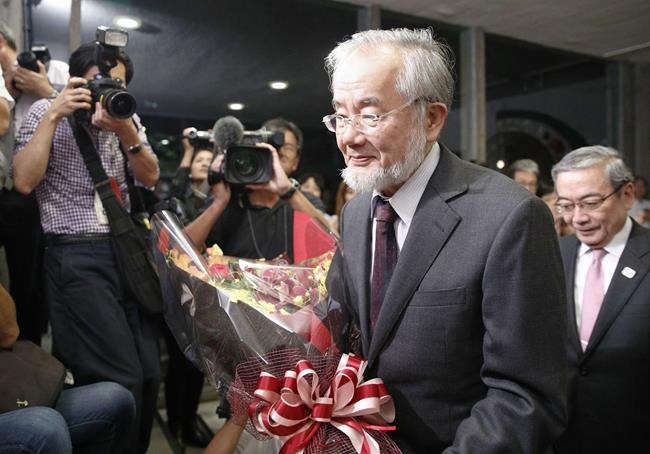
STOCKHOLM – The Latest on the first of this year’s Nobel Prizes: the award in medicine or physiology (all times local):
2:30 p.m.
Nobel medicine prize winner Yoshinori Ohsumi says that he hopes a younger generation of scientists will follow up on his research to explore unanswered questions about autophagy.
The Japanese biologist was honoured for experiments in the 1990s on autophagy, the “self-eating” process with which cells break down and recycle some of their content.
Ohsumi told reporters in Tokyo that he hopes said that “younger scientists find the topic interesting and join the research.”
The scientist spent decades looking at yeast under a microscope as part of his research.
Ohsumi said that “there is no finish line for science. When I find an answer to one question, another question comes up. I have never thought I have solved all the questions. So I have to keep asking questions of the yeast.”
___
2:15 p.m.
Nobel medicine prize winner Yoshinori Ohsumi says that it was his “dream as a boy” to win the award.
But the Japanese biologist told reporters at the Tokyo Institute of Technology, where he is a professor, that as an adult scientist he wasn’t aiming for the award with his research. He said that he didn’t really consider that “my research would lead to a Nobel Prize.”
Ohsumi was honoured for experiments in the 1990s on autophagy, the “self-eating” process with which cells break down and recycle some of their content.
Ohsumi also said that being in a high-profile competition isn’t his style and that he preferred monitoring yeast in his microscope day after day.
He said “that’s what science is all about, and the joy of finding something inspires me.”
___
2:05 p.m.
A researcher says that Nobel medicine prize winner Yoshinori Ohsumi’s work “opened the door to a field.”
Ohsumi was honoured for experiments in the 1990s on autophagy, the “self-eating” process with which cells break down and recycle some of their content.
Dr. David Rubinsztein, deputy director of the Cambridge Institute for Medical Research at the University of Cambridge, says Ohsumi’s research “provided tools to the whole world to start trying to understand how autophagy is important” in mammals.
He said that scientists were aware of autophagy before his work, but “they didn’t know what it did, they didn’t know how it was controlled and they didn’t know what it was relevant for.”
Rubinsztein said that now “we know that autophagy is important for a host of important mammalian functions.”
___
12:35 p.m.
Japanese scientist Yoshinori Ohsumi says that he’s “extremely honoured” to have been awarded this year’s Nobel Prize in medicine for discoveries related to the auto-decomposition and recycling of cellular components.
Ohsumi, who was speaking in a live phone interview with Japanese broadcaster NHK, was honoured for experiments in the 1990s on autophagy, the “self-eating” process with which cells break down and recycle some of their content.
When asked why autophagy became his project, Ohsumi said that “I wanted to do something different from other people. I thought auto-decomposition was going to be an interesting topic.”
Ohsumi, speaking in Japanese, also said that the “human body is always repeating the auto-decomposition process, or cannibalism, and there is a fine balance between formation and decomposition. That’s what life is about.”
___
11:35 a.m.
Japanese scientist Yoshinori Ohsumi has been awarded this year’s Nobel Prize in medicine for discovering the mechanisms of autophagy.
The Karolinska Institute said autophagy is a “fundamental process for degrading and recycling cellular components.”
___
10:20 a.m.
The Nobel Assembly at Stockholm’s Karolinska Institute is getting ready to announce the first of this year’s Nobel Prizes: the award in medicine or physiology.
It will be the 107th award in that category since the first Nobel Prizes were handed out in 1905.
The prize committee often awards discoveries that were made decades ago, to make sure that they’re still relevant.
Last year’s prize was shared by three scientists who developed treatments for malaria and tropical diseases.
The 2016 medicine prize is set to be announced at 11:30 a.m. in Stockholm (0930 GMT).
The announcements continue with physics on Tuesday and chemistry on Wednesday and the Nobel Peace Prize on Friday. The economics and literature awards will be announced next week.
Each prize is worth 8 million kronor ($930,000).
News from © The Associated Press, . All rights reserved.
This material may not be published, broadcast, rewritten or redistributed.

This site is protected by reCAPTCHA and the Google Privacy Policy and Terms of Service apply.
Want to share your thoughts, add context, or connect with others in your community?
You must be logged in to post a comment.