Elevate your local knowledge
Sign up for the iNFOnews newsletter today!
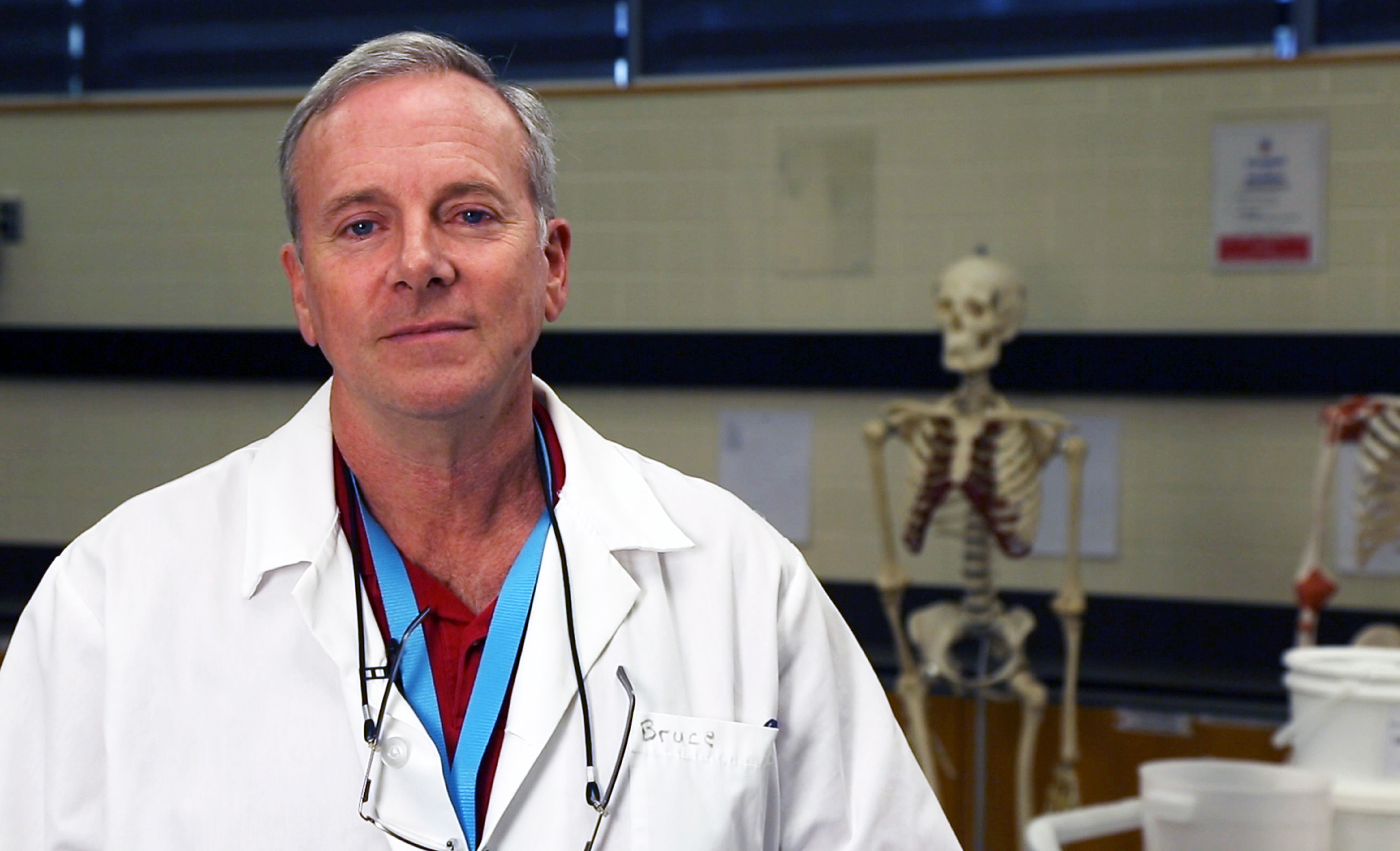
KELOWNA – For those who traditionally learned about anatomy outside medical school, figuring out what the human brain looks like inside the skull was largely a textbook exercise.
Diagrams with arrows and text descriptions acted as a roadmap with student absorption largely reliant on memorization. In the age of the Internet and Instagram, it’s a model that educators may need to improve on if they are to meet students’ interactive learning expectations, says UBC Assoc. Prof. Bruce Mathieson.
“My students have been telling me that most of them are visual learners, that they don’t necessarily retain all the information they need from attending lectures and taking notes,” says Mathieson, who teaches biology at UBC Okanagan’s Irving K Barber School of Arts and Sciences. “Technology is a way of life for most of today’s students, and visuals are a huge part of that.”
With visuals in mind, Mathieson has been working on bringing textbook learning to the computer screen. In addition to creating seven videos detailing a dissection of the human brain, he received a $9,750 Curriculum Innovation Award to hire a programmer and create a tool that allows students to virtually navigate the brain on their laptops. Mathieson completed the tool last month, which he refers to as a first step into a more distributed model of learning.
“It’s like a little video game, you can navigate and isolate the various areas of the brain and it’s a way of putting pictures to the parts of the brain anatomy you are learning about,” says Mathieson. “Students are telling me that they are spending a lot more time looking at the material, and I find many of them are getting upwards of 95 percent on their tests.”
For their part, Mathieson’s students say that the interactive learning tools help with their studies.
“The concept of neuroanatomy was one of the more challenging aspects of my education,” said Mathieson’s student Shane Simon. “I found it to be quite an advantage to be able to virtually walk through the material, step-by-step, nucleus by nucleus, in my own way and in my own time.”
“Instead of just memorizing the material from a textbook, this tool allowed me to see real-life structures of the brain and the names associated with them, which is fun,” said fellow student Iman Zahirfar. “Because of the set-up of the tool, I became more curious as to what each structure did and actually ended up studying more as a result.”
Technology is playing an increasingly important role in today’s educational environment, says Michelle Lamberson, UBC’s Director of Flexible Learning and Special Projects.
“With today’s rate of information turnover, memorizing and repeating information is a bit of an outdated model,” says Lamberson. “Faculty can use technology to structure content in innovative ways that encourages students to explore and better own their learning process.
“With Bruce’s approach, he is not only allowing students to see something that is not normally accessible to the eye, he has also provided a rich context for interacting with a complex anatomical structure. These types of environments can provide powerful learning experiences for students.”
At UBC Okanagan, encouraging new and innovative ways for teaching and learning is a priority. This year, the campus unveiled its Aspire Learning and Teaching Fund that provides faculty with up to $50,000 for new and innovative projects.
News from © iNFOnews.ca, . All rights reserved.
This material may not be published, broadcast, rewritten or redistributed.

This site is protected by reCAPTCHA and the Google Privacy Policy and Terms of Service apply.
Want to share your thoughts, add context, or connect with others in your community?
You must be logged in to post a comment.